One of the most basic tools of the geography and political science is the political map. It symbolizes the separations of the surface of the earth through human rule in terms of country, state, province, and city. In contrast to physical maps where the main focus had been placed on the natural features such as mountains or rivers, political maps were made to highlight the man-made borders and interdependencies between the various administrative regions. These maps give an easy visual picture of the distribution of political power in the world.
Political maps are treated not only as academic instruments but they are also necessary to comprehend the international relations, the system of governance and the structuring of the land. Such maps are very legible because of the use of color, labels and symbols that enable the user to differentiate various regions readily. The political map is a valuable tool which helps a person to understand how political power is organized, which countries are in conflict as well as the global coalitions.
- Shows manmade boundaries of the earth.
- Dwelling on nations, provinces and cities.
- A key to learning about the world and its governance.
Definition and Characteristics of Political Map
To be formally defined a political map can be defined as a representation of boundaries of territory that are based on political authority or historical accords and can be represented on two dimensions. These maps are utilized in determining the geopolitical structure of the earth, in which land is formed into nations and sub national units. Generally, political maps are drawn to show boundaries of nations, and capitals, and large cities, as well as the lines that symbolize the state or provincial boundaries. The visual separation of the areas is done by color differentiation with different parts of the region getting shaded differently to increase the clarity. Within the academic and administrative environment, political maps can be regarded as the essential source of information on the existence of the boundaries of jurisdiction, the structure of the region, and the population.
- Identifies political areas and areas of governance.
- Identifies by the use of colors and symbols.
- Has national and sub national divisions.
Political maps in this way are not merely tools of a geographical kind, but they are also tools of political cognition. They mirror the historic past and the modern day power politics and how they relate and co-exist within set boundaries.
Historical Development of Political Maps
The idea of political maps is not new; it dates back to the ancient times when people tried to delimit the areas and document them. The early empires including Mesopotamia, Egypt and Rome created some of the earliest territorial maps to administer the land ownership, taxation and defense. As time progressed the political maps could assume a more global shape as cartography developed in the Age of Exploration (15th17th centuries). The European explorers and colonialists mapped new lands and this marked political control and influences across the continents.
The era of modern world has seen the introduction of technology into the political map-making and maintenance systems and the use of satellite images and geographic information systems (GIS) has revolutionized the way the political maps are made and kept. The current day maps are precise, data based and constantly updated, capturing the realities of political developments of the time like the formation of a new nation or change of a border.
- Their origin was in the ancient territorial management.
- Polished in the Age of Exploration.
- Digitized and satellite technology.
The geopolitical history of the political maps proves the permanent necessity of human to determine the space, authority, and identity of the geopolitical space.
Key Elements of a Political Map
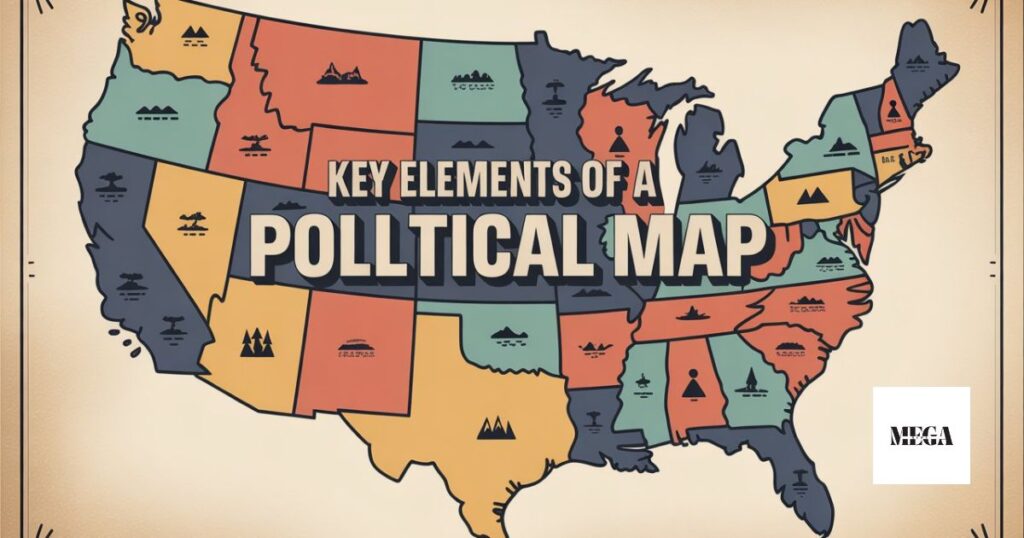
The political maps consist of a number of critical components that make them more readable and functional. The most striking are the boundaries which are usually written in solid lines separating a country or a retail region. Nations are separated by colors and underlining political independence. As an example, the neighboring countries are generally displayed in different shades of contrast to prevent confusion.
Other important elements are the country, state, and big cities names as well as the symbols, namely stars or dots, demonstrating the capitals or administrative towns. The legend (key) defines the semantics of symbols, and the scale gives data about the relationships of distances. Direction can also be indicated by a compass rose.
- Boundaries and color codes
- Capitals and major cities
- Scale, legend on the map and compass rose.
All the aspects of a political map collaborate to form a detailed visual pattern of the political partitioning and management of the world.
Applications and use of Political Maps
The applications of political maps are very numerous at the academic, governmental, and business levels. They are also indispensable in the educational field where they can teach students the geography of the world, international borders, and capital cities. Political maps are useful in planning, governance and policymaking by governments particularly in matters relating to territorial claims or management of resources.
Political maps are important in the international relations because they enable countries to depict geopolitical boundaries and regional alliances in the diplomatic negotiation. Besides, these maps are used by travelers and businesses to plan their navigation, logistics, and trade. The maps are also primary sources of information in the news media where they are utilized to describe the events, wars and political developments around the world.
- Studies in education and geography.
- State organization and foreign policies.
- Logistics and travel coordination of business.
Therefore, political maps are not limited to the classroom setting but are part of numerous areas of the global knowledge and decision-making.
Variation in Political and Physical Maps
Political maps therefore represent the way human beings layout the land and physical maps the way nature outlines it. To take an example, a political map of Asia will indicate the frontiers of China, India and Pakistan, and on the other hand, a physical map will accentuate the Himalayas, rivers such as the Ganges and plains surrounding it. These two types of maps are complement to one another; they give us a complete picture in terms of the geographical picture of the world.
- The boundary of politics Human-made boundaries.
- Physical map Physical map Natural landforms.
- Political = Governance; Physical = Geography.
It is important to understand both of them in order to gain the insight into a complex relationship between geography, politics, and human settlement.
The Significance of Political Maps in the International world
In the current globalized world, political maps cannot be ignored. They form the basis of geopolitical consciousness in that individuals and institutions can understand balance of power in the world. The maps help the international organizations, including the United Nations, NATO and the European Union in examining regional boundaries and addressing the cross-border matters.
Political maps are also useful in the analysis of events in the world. In case of political conflict or territorial issues, maps are important resources in determining the regions that are affected. They develop the critical thought over the sovereignty, colonization, and global development in academia.
- Encourages geopolitical awareness.
- Supports foreign agencies and diplomacy.
- Funds education and policy making.
Thus, the political maps continue to be a pillar of the strategic analysis, education and government associating geography to human authority.
Interpretation and Reading a Political Map
In order to be able to read a political map, one should comprehend its symbols, patterns of colors, and scale. The legend itself reveals the key to the information decoding; it can be used to understand what this or that line and mark means. Colors denote the specific countries or regions whereas the symbols represent the significant cities or capitals. The scale assists the reader in making estimations of the distance between locations, as well as understanding the spatial relationships better. It is also accompanied with the identification of patterns of proximity, size, and complexity of boundaries when reading a political map.
- Examine the legend and coloring.
- Record scale and demarcations.
- Examine spatial relations between countries.
- Therefore, one needs to read a political map carefully and have some geographical logic to it.
Current Political Mapping Progressions
Political mapping has taken a new turn in the application of modern technology. The use of digital technology like Geographic Information Systems (GIS), satellite images and online interactive maps has transformed the manner political information is gathered, presented and interpreted. These systems enable the real-time update, and therefore political changes, such as new frontiers or renamed regions are updated in near real-time.
Besides this, data visualization and 3D modeling are now applied in organizations to improve the understanding of maps. These advancements are useful to educational institutions and the researchers because dynamic visual aids can be used to analyze them further. Modern mapping systems are also very important in strategic planning and security management by governments and defense agencies.
- Applications: Technological Advancements:
- GIS and satellite-orientated mapping.
- Interactive online maps
- Real-time political updates
These inventions have made political maps no longer a document using a particular map, but a tool of analysis and decision-making.
Conclusion
To sum up, a political map is much more than the mere map of the borders and cities, it is a representation of how human civilization is organized and governed. Ever since ancient empires, the political maps assisted the mankind in defining identity, control, and collaboration on a regional level. They are still vital that facilitate education, administration, diplomacy, and research.
Learning the political maps, a person gets a clue about how the power is constructed, how territories are divided, and the relationships which present our world. Political maps will not disappear soon as the world keeps presenting a new image of the world relations and informing the world about making informed decisions.
FAQ’s
1. What are the key applications of political maps?
They are applied in education, governance, travel plan and international relations.
2. What is the importance of political maps in the contemporary world?
They assist individuals in realizing political demarcation, geographical conflicts, and international configuration.