The fuel prices are never politically, economically and socially neutral. Pakistan Petrol (gasoline) in Pakistan is important in the budget of houses, transport cost, inflation and industry. Due to the fact that fuel cost ripples across all sectors (transport, food, and manufacturing) even slight alterations in the petroleum prices provoke political debates, demonstrations, or political interventions.
This paper will give a comprehensive and more current overview of the petrol price in Pakistan: how the pricing is determined, the factors that contribute to the change every day, the regional anomaly, recent experience of 2025/2026, its effects on the consumer and the business, and the future of the country.
The Determination of the Petrol Prices in Pakistan

- International Crude Oil Prices
This refers to the market value of crude oil products as traded internationally. International Crude Oil Prices This is the market value of the crude oil products that are traded in the international market.
Any petrol rate in Pakistan has its roots in international crude oil market. Pakistan is an importer of the majority of its crude and refined petroleum products (e.g. imports of Gulf countries). The domestic petrol prices follow suit when international crude prices are increased (through OPEC actions, supply shocks, political crises, etc.), but with conversion and profit margin added on.
- Exchange Rate (PKR / USD)
The exchange rate is a significant multiplier because the petroleum imports are quoted in US dollars. When the Pakistani rupee weakens, then despite the flatness of crude the cost of oil imports in rupees goes up hence the domestic petrol prices increase.
- Taxes, Duties & Levies
A number of taxes and duties on petrol are imposed by the government (federal and provincial). These include:
- Petroleum levy
- Excise duties
- Wholesaler, distributor and dealer margin.
- Cost of transportation, storage and handling.
These provide a considerable element of tax burden to the retail petrol price; as tax policies vary so does the final pump price.
- Margins and Logistics
Between import to import terminal, import terminal to wholesale depot and finally to the fuel pump the costs are:
- Freight / shipping / handling
- Storage, insurance, losses (evaporation, spillage)
- Distribution trucking
- Trade commission and overheads.
Such logistical expenses depend on the province, distance to import terminals, quality of infrastructure and fuel requirement.
- Regulatory Mechanism: The Petroleum Policy
The Petroleum Policy / formulation mechanism set up in Pakistan dictates the rate of review (weekly, bi-weekly, monthly), the days of buffer inventory to be taken into consideration, whether government takes over volatility and the extent to which the fluctuations are transferred to consumers.
Other governments prefer to buffer fuel volatility (to absorb increases through subsidies) to rescue consumers, whereas others would prefer their markets to pass-through. The balance indicates the politics, the available fiscal space, and inflation control.
Trends in 2025–2026

1. Historical Instability
In the past years, the petrol prices in Pakistan have been changed frequently, even at the expense of one week. Egregious world oil shocks, foreign currency movements or tax changes have caused sudden spikes or reductions.
For example:
- The 202425 crude oil increases drove the rates high.
- Relief was periodically observed as the government cut petroleum levies or permitted some subsidy takeover.
- Sometime the government was sluggish in adaptation so that it would not be backlashed at home; it led to a sudden late appreciation.
2. Recent Price Levels
These numbers are not an indicator of stable international situations, currency pressures and national taxes.
As an example, when the rupee loses by 5 or crude oil increases by 8, the impact is immediately reflected in the prices of the pumps within days as the rates are modified.
3. Daily / Weekly Adjustments
During most of the times, the government or any other controlling body (such as OGRA in certain provinces) publishes weekly petrol updates. These are announcements that will show the new per-liter prices, how the price has gone up or down since the previous week.
The adjustments are small (many times, by a few rupees per liter), though when the market is volatile, they can be big (1015 rupees or even higher). The rates may be held steady over weeks in order to protect consumers, or they may change frequently in order to match the import cost environment.
4. Provincial Variation
There is no uniformity in petrol prices in Pakistan. Differences arise due to:
- Different provincial taxation/ surcharge.
- Terminal distance / infrastructure expense.
- Local levies or duties
This is the reason why petrol may be marginally cheaper in Karachi (since it is near ports of imports) than in distant regions such as Punjab or Khyber Pakhtunkhaw where transportation and logistics expenses are tacked on to the retail price.
Recent Changes & Policy Moves
1. Reduction of Petroleum Levy or Surcharges
Some governments have sometimes reduced the levy on petroleum or even waived some of the tax burden to reduce the burden on consumers. Such decisions are usually made before elections or considerations of larger relief packages.
2. Fuel Subsidy Announcements
When facing emergencies (whether due to a crisis or politically sensitive times) temporary governments subsidies (full or partial) can be announced so that prices of petrol do not suddenly increase. However, despite these subsidies being of a benefit to the people, they are a cost burden and may lead to fuel shortages or rationing.
3. Review Frequency Revisions
It has been debated in political and economic quarters whether it should be changed with respect to the rate of petrol rate reviews. Others believe in adjustments daily or bi-daily in line with actual market trends; others emphasize consistency to prevent constant shocks to consumers.
4. Increased Transparency & Forecasting
There have been calls to be more transparent: to release the way import costs, exchange rates, inventories buffers and tax elements are fed into final pump price. Other policy proposals include release of forecasted petrol rate ceilings to discourage speculation and national outrage.
Effects of Fluctuation in Petrol Price
1. Inflation & Cost of Living
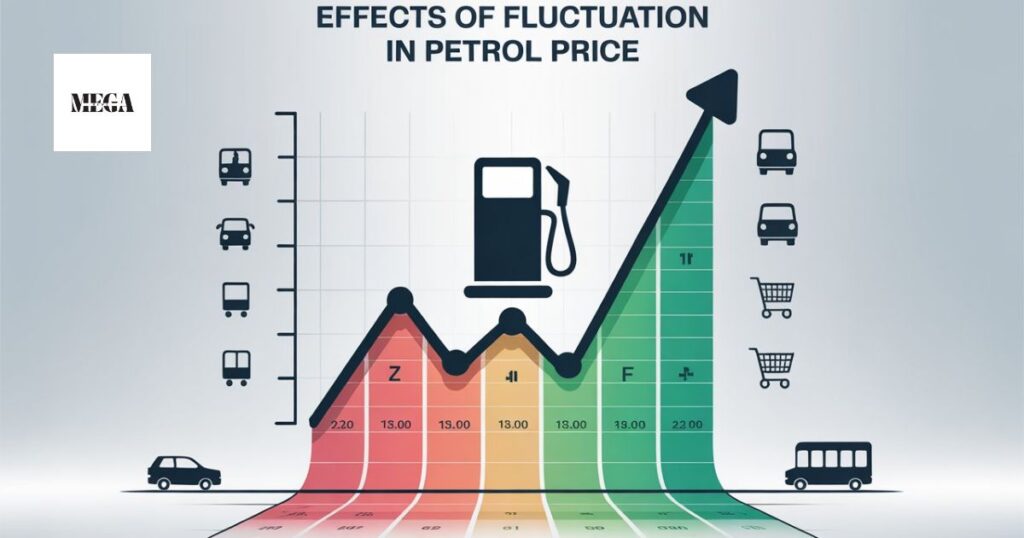
Fuel cost influences practically every aspect food transport, raw materials transportation, freight, public transport charges, electricity generators etc. The 10-rupee price per liter spill over to a rise in the prices of products and consumer items.
2. Public Transport & Commuting
When petrol goes up, auto rickshaw, bus and van fares are also usually adjusted. Daily city commuters find fuel increases sharp to the teeth. Access to fuel can affect the mobility of farmers, small producers even in rural areas.
3. Power Generation and Energy Industry
There are also certain industries and auto produced power producers who depend on diesel or petrol in the area. Fuel cost change also influences the cost of production, electricity tariffs (when there is backup generation) and competitiveness of industry.
4. Business, Logistics, Manufacturing
Expensive input costs can be experienced in freight, logistics and manufacturing sectors. Margins become smaller and businesses tend to transfer those expenses to consumers- putting more pressure on inflation.
5. Consumer Behavior
Rise in fuel price may result in decreased consumption of personal vehicles, greater use of transport or collective mobility, and in other cases panic buying and hoarding before rates go up.
Example: Recent Weekly Change
The following is a simplified (to explain) example of how a recent weekly change in petrol rates could appear:
| Date | Last Price | Movement | New Price | Rationale / Motives |
| 15 July 2025 | Rs 292.75 | +5.00 | Rs 297.75 | Increase in cost of fuel freight. |
| 22 July 2025 | Rs 297.75 | 0.00 | Rs 297.75 | Government freeze to consumer relief. |
Such changes in the real life are declared through the announcement; the ministry of finance / petroleum divisions is often one of the announcers.
The Recent Public Reactions and Media Coverage

Increase in fuel prices is a common issue that stirs the citizens into angry outcry, political commentary, cartoons, and demonstrations. Some of the most repeated media and popular discussions are:
- Demands of subsidized fuel to the poor.
- Opposition to the fuel tax load.
- Demand in being transparent in price-building.
- Grievances of strikes of truckers or increase in fares of transporters.
- Social media posts on a comparative basis against other countries on the prices of petrol.
When there are large jump, such reactions have been common in 2025/2026. The pressure has been put on some regional governments to lower their provincial surcharges.
Strains & Stability Busting
- Fiscal pressure: The government budgets and debt are impacted by subsidies or absorbing cost.
- Smuggling / illicit trade: Fuel smuggling into the neighboring countries, where there is a difference in prices, is a constant threat.
- Political restrictions: Sometimes the government is delayed in making corrections to prevent the backlash and this leads to abrupt big corrections.
Outlook & Forecast
Near Term (next 3–6 months)
- Anticipate slight changes weekly, 2-6 rupees per liter, based on the trends in crude and currency.
- In case oil markets remain unchanged or even fall, the government can freeze rates or even reduce by a little.
But when crude rises/rupee depreciates, keep a look out on sharp jumps.
Medium Term (2026)
- Political cycles (elections): More relief-oriented policies can be induced by political cycles, such as temporary fuel subsidies.
- Policy reforms can advocate the more frequent and open changes.
- That is, investments in alternative energy (electric vehicles, renewable power) may be accelerated in case petrol will be still expensive.
Tips for Consumers

- Keep up with weekly changes – ministry or government sites will frequently change the petrol rates.
- Allowance on fuel volatility in the monthly household expenses.
- Maximize fuel consumption — carpooling, mass transportation, economical driving saves expenses.
- Look into other options — in cities, EVs or CNG (where there is one) can provide relief.
- Be aware of the tax policy, as when governments suggest reducing fuel taxation or an imposition, they can be temporary relief.
Conclusion
In Pakistan, petrol prices are an issue with multiple layers that involve oil markets in the world, exchange rate, taxation, transportation, and political decisions. Adjustments on a daily or weekly basis have become the order of the day in 2025/2026 with the volatility in the crude and the pressure on the rupee. The fuel cost pressure is acutely experienced at the household, transport, industries, and inflation index levels.
Going forward, the establishment of buffers, enhancement of transparency, and alleviation of volatility will be important to the stability of the Pakistan economy. Immediately, as a consumer, the ability to be informed, spend wisely, and consider options is one of the survival tactics in the world today where the price of fuel is seldom constant.
I could also put together a live price tracker mockup, or a compilation of city-by-city petrol pricing in Pakistan (Karachi, Lahore, Islamabad etc.) in 202526, updated every day, as you like. Wilt thou have me give the next that?
FAQs Petrol Price in Pakistan
Q1: Who sets petrol prices in Pakistan?
A: Petrol prices in Pakistan are determined by the federal government based on recommendations from the Oil and Gas Regulatory Authority (OGRA), considering international crude prices, exchange rates, and taxes.
Q2: How often do petrol prices change in Pakistan?
A: Petrol prices are typically revised on a bi-weekly basis(every 15 days), but sometimes adjustments are made weekly or even delayed due to political or fiscal considerations.
Q3: What is the current petrol price in Pakistan?
A: As of late 2025, petrol prices are in the range of Rs 280 – Rs 305 per liter, depending on global markets and government tax policy. (Always check the latest official notification for exact rates.)
Q4: Why do petrol prices in Pakistan change so frequently?
A: Changes occur because Pakistan imports most of its fuel. Variations in global crude oil prices, the US dollar exchange rate, and government taxes/levies directly impact the final consumer price.